Commerce Secretary Howard Lutnick raised the concern with ASML's leadership in private meetings, according to Bloomberg. ASML says it has never shipped its most advanced chipmaking tool to China, and no public evidence has surfaced.
US Commerce Secretary Howard Lutnick has told ASML's senior leaders he is concerned that one of the Dutch company's extreme ultraviolet (EUV) lithography machines may have reached China, in violation of US-led export controls, Bloomberg reported on Friday, citing people familiar with the talks. The concern was raised in a series of recent meetings between Lutnick and executives at ASML, the only company in the world that builds EUV systems.
ASML rejected the suggestion outright. In a statement to Reuters, the company said it has never shipped an EUV machine to China, nor any component or module specifically designed for one. According to Bloomberg, ASML went further and circulated a document in Washington stating there is no indication of any of its EUV systems being in the country. The US Commerce Department did not respond to questions, including whether it has any evidence that such a machine is in China.
Why EUV is the chokepoint
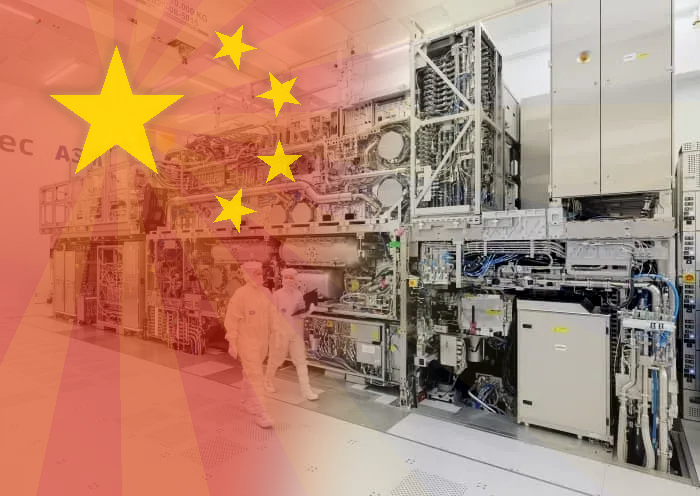
EUV lithography sits at the center of the modern chip industry. ASML holds a global monopoly on the technology, which uses extreme ultraviolet light to etch the smallest features onto silicon and is required to manufacture the most advanced processors, the sub-7nm chips that run frontier AI systems and high-performance computing. Customers for these tools include TSMC, Samsung, and Intel.
China has never been allowed to buy one. The Netherlands blocked the export license in 2019 under pressure from the first Trump administration, and EUV has been off-limits to Chinese buyers ever since.
That history is what makes the allegation significant. A confirmed EUV machine inside China would be the first known break in an export-control system that Washington and its allies have spent years building, and it would hand Beijing a capability it has so far been unable to reproduce. Reuters reported in December 2025 that Chinese researchers, including former ASML engineers, are working on a prototype EUV machine in an effort described as the country's version of the Manhattan Project. Progress, by most accounts, has been slow.
ASML's defense
ASML's pushback rests on the physical reality of the machines. The systems are roughly the size of a school bus, weigh about 180 metric tons, and are produced in small numbers. Standard EUV systems cost on the order of $150 million to $200 million, while the newest High-NA generation runs closer to $370 million to $400 million. They ship disassembled across dozens of containers and multiple Boeing 747 cargo flights, and they require constant on-site maintenance from ASML technicians to keep running.
The company's point is that such a machine cannot be quietly diverted, and would be of limited use to anyone without its ongoing support.
ASML shares fell as much as 2.7% in Amsterdam on Friday.
Get the ICD Newsletter
Subscribe for source-forward cyber news, OSINT notes, breach updates, and analysis. Have evidence or a lead? Send it to ICD.