
Discord users are reporting a wave of suspensions and permanent bans after posting ordinary images containing grid or checkerboard patterns. Reported triggers include Minecraft inventory screenshots, spreadsheets, chessboards, transparent-background checkerboards, and tiled game textures. According to affected users, the images were flagged by Discord's child safety systems, and the resulting enforcement was automatic. The community has taken to calling it the "grid ban."
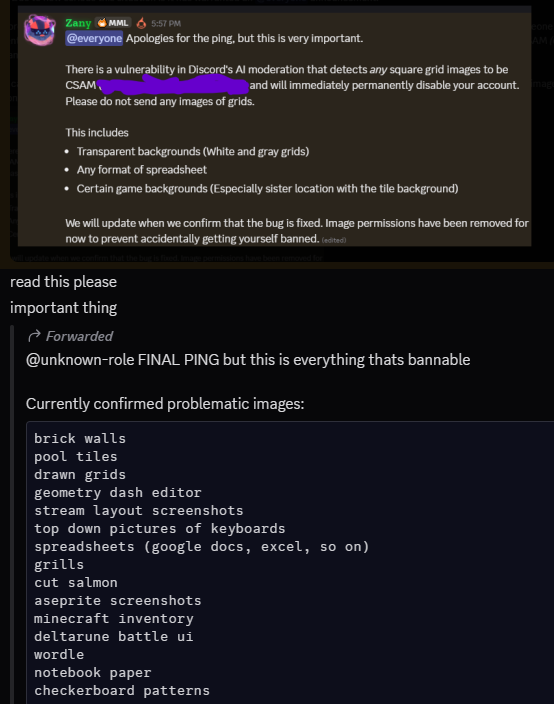
Discord has not publicly acknowledged the issue. Affected users say their appeals are returning automated responses or sitting in queue with no timeline. Server owners have responded by warning members not to post grid imagery, and some have revoked image permissions entirely as a precaution.
A theory circulating in Discord moderator communities holds that abusers overlaid child sexual abuse material with grid patterns to evade earlier filters, and that Discord's detection model learned to associate the grid itself with abuse material. It is a plausible story about how a classifier ends up keying on the wrong feature, but it is speculation. Discord has said nothing about its detection pipeline.
There is one data point that complicates the Discord-only framing. A developer at indie games marketplace itch.io says the site received a batch of automated child abuse reports after moving its image hosting to Cloudflare, all for images of plain gray grids. The same developer says their personal Discord account was banned over game textures.
That parallel matters because of how this kind of detection usually works. Most major platforms and hosting providers do not each judge images from scratch. They compare digital fingerprints of uploaded images, known as hashes, against shared industry databases of known abuse material. Cloudflare's scanning tool for hosting customers works this way. The technique is deliberately fuzzy so that cropped or slightly edited copies still match, but that fuzziness has a known weakness. Simple, repetitive, low-detail images like a flat gray grid produce generic fingerprints that are more likely to collide with database entries.
If a grid-heavy image made it into a shared list, or if matching thresholds are too loose for that class of image, every service consuming that list could start misfiring on grids at roughly the same time. That would explain two unrelated systems tripping on the same visual pattern in the same week better than a Discord-specific training error does. It remains unconfirmed. Neither Discord nor Cloudflare has said which mechanism produced the flags, and the itch.io account rests on one developer's public posts.
Get the ICD Newsletter
Subscribe for source-forward cyber news, OSINT notes, breach updates, and analysis. Have evidence or a lead? Send it to ICD.